Reference Counting Basics
A PHP variable is stored in a container called a "zval". A zval container
contains, besides the variable's type and value, two additional bits of
information. The first is called "is_ref" and is a boolean value
indicating whether or not the variable is part of a "reference set". With
this bit, PHP's engine knows how to differentiate between normal variables
and references. Since PHP allows user-land references, as created by the
& operator, a zval container also has an internal reference counting
mechanism to optimize memory usage. This second piece of additional
information, called "refcount", contains how many variable names (also
called symbols) point to this one zval container. All symbols are stored in
a symbol table, of which there is one per scope. There is a scope for the
main script (i.e., the one requested through the browser), as well as one
for every function or method.
A zval container is created when a new variable is created with a constant
value, such as:
Example #1 Creating a new zval container
<?php
$a = "new string";
?>
In this case, the new symbol name, a, is created in the current scope,
and a new variable container is created with the type string and the value
new string. The "is_ref" bit is by default set to false because no
user-land reference has been created. The "refcount" is set to 1 as
there is only one symbol that makes use of this variable container. Note
that references (i.e. "is_ref" is true) with "refcount" 1, are
treated as if they are not references (i.e. as "is_ref" was false). If you have » Xdebug installed, you can display this
information by calling xdebug_debug_zval().
Example #2 Displaying zval information
<?php
$a = "new string";
xdebug_debug_zval('a');
?>
The above example will output:
a: (refcount=1, is_ref=0)='new string'
Assigning this variable to another variable name will increase the refcount.
Example #3 Increasing refcount of a zval
<?php
$a = "new string";
$b = $a;
xdebug_debug_zval( 'a' );
?>
The above example will output:
a: (refcount=2, is_ref=0)='new string'
The refcount is 2 here, because the same variable container is linked
with both a and b.
PHP is smart enough not to copy the actual variable
container when it is not necessary. Variable containers get destroyed when
the "refcount" reaches zero. The "refcount" gets decreased by one when any
symbol linked to the variable container leaves the scope (e.g. when the
function ends) or when a symbol is unassigned (e.g. by calling unset()).
The following example shows this:
Example #4 Decreasing zval refcount
<?php
$a = "new string";
$c = $b = $a;
xdebug_debug_zval( 'a' );
$b = 42;
xdebug_debug_zval( 'a' );
unset( $c );
xdebug_debug_zval( 'a' );
?>
The above example will output:
a: (refcount=3, is_ref=0)='new string'
a: (refcount=2, is_ref=0)='new string'
a: (refcount=1, is_ref=0)='new string'
If we now call unset($a);, the variable container, including the type
and value, will be removed from memory.
Compound Types
Things get a tad more complex with compound types such as arrays and
objects. As opposed to scalar values, arrays
and objects store their
properties in a symbol table of their own. This means that the following
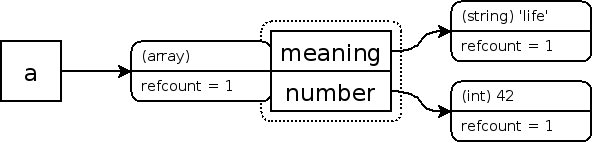
example creates three zval containers:
Example #5 Creating an array zval
<?php
$a = array( 'meaning' => 'life', 'number' => 42 );
xdebug_debug_zval( 'a' );
?>
The above example will output
something similar to:
a: (refcount=1, is_ref=0)=array (
   'meaning' => (refcount=1, is_ref=0)='life',
   'number' => (refcount=1, is_ref=0)=42
)
The three zval containers are: a, meaning, and number.
Similar rules apply for increasing and decreasing "refcounts". Below, we add another
element to the array, and set its value to the contents of an already
existing element:
Example #6 Adding already existing element to an array
<?php
$a = array( 'meaning' => 'life', 'number' => 42 );
$a['life'] = $a['meaning'];
xdebug_debug_zval( 'a' );
?>
The above example will output
something similar to:
a: (refcount=1, is_ref=0)=array (
   'meaning' => (refcount=2, is_ref=0)='life',
   'number' => (refcount=1, is_ref=0)=42,
   'life' => (refcount=2, is_ref=0)='life'
)
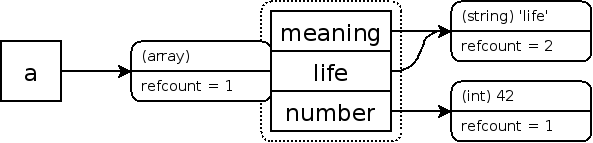
From the above Xdebug output, we see that both the old and new array
elements now point to a zval container whose "refcount" is
2. Although Xdebug's output shows two zval containers
with value 'life', they are the same one. The
xdebug_debug_zval() function does not show this, but
you could see it by also displaying the memory pointer.
Removing an element from the array is like removing a symbol from a scope.
By doing so, the "refcount" of a container that an array element points to
is decreased. Again, when the "refcount" reaches zero, the variable
container is removed from memory. Again, an example to show this:
Example #7 Removing an element from an array
<?php
$a = array( 'meaning' => 'life', 'number' => 42 );
$a['life'] = $a['meaning'];
unset( $a['meaning'], $a['number'] );
xdebug_debug_zval( 'a' );
?>
The above example will output
something similar to:
a: (refcount=1, is_ref=0)=array (
   'life' => (refcount=1, is_ref=0)='life'
)
Now, things get interesting if we add the array itself as an element of
the array, which we do in the next example, in which we also sneak in a
reference operator, since otherwise PHP would create a copy:
Example #8 Adding the array as an element of itself
<?php
$a = array( 'one' );
$a[] =& $a;
xdebug_debug_zval( 'a' );
?>
The above example will output
something similar to:
a: (refcount=2, is_ref=1)=array (
   0 => (refcount=1, is_ref=0)='one',
   1 => (refcount=2, is_ref=1)=...
)
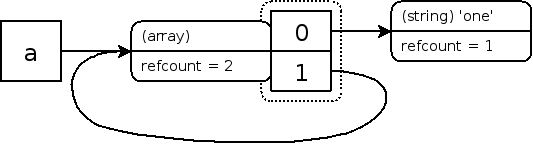
You can see that the array variable (a) as well as the second element
(1) now point to a variable container that has a "refcount" of 2. The
"..." in the display above shows that there is recursion involved, which,
of course, in this case means that the "..." points back to the original
array.
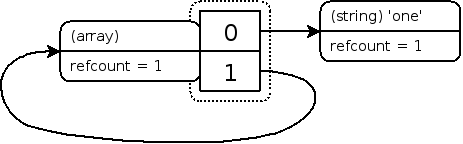
Just like before, unsetting a variable removes the symbol, and the
reference count of the variable container it points to is decreased by
one. So, if we unset variable $a after running the above code, the
reference count of the variable container that $a and element "1" point to
gets decreased by one, from "2" to "1". This can be represented as:
Example #9 Unsetting $a
(refcount=1, is_ref=1)=array (
   0 => (refcount=1, is_ref=0)='one',
   1 => (refcount=1, is_ref=1)=...
)
Cleanup Problems
Although there is no longer a symbol in any scope pointing to this
structure, it cannot be cleaned up because the array element "1" still
points to this same array. Because there is no external symbol pointing to
it, there is no way for a user to clean up this structure; thus you get a
memory leak. Fortunately, PHP will clean up this data structure at the end
of the request, but before then, this is taking up valuable space in
memory. This situation happens often if you're implementing parsing
algorithms or other things where you have a child point back at a "parent"
element. The same situation can also happen with objects of course, where
it actually is more likely to occur, as objects are always implicitly used
"by reference".
This might not be a problem if this only happens once or twice, but if
there are thousands, or even millions, of these memory losses, this
obviously starts being a problem. This is especially problematic in long
running scripts, such as daemons where the request basically never ends,
or in large sets of unit tests. The latter caused problems while
running the unit tests for the Template component of the eZ Components
library. In some cases, it would require over 2 GB of memory, which the
test server didn't quite have.



 Garbage Collection


 Garbage Collection